8 Best Castle Towns for Slow Travel in Europe
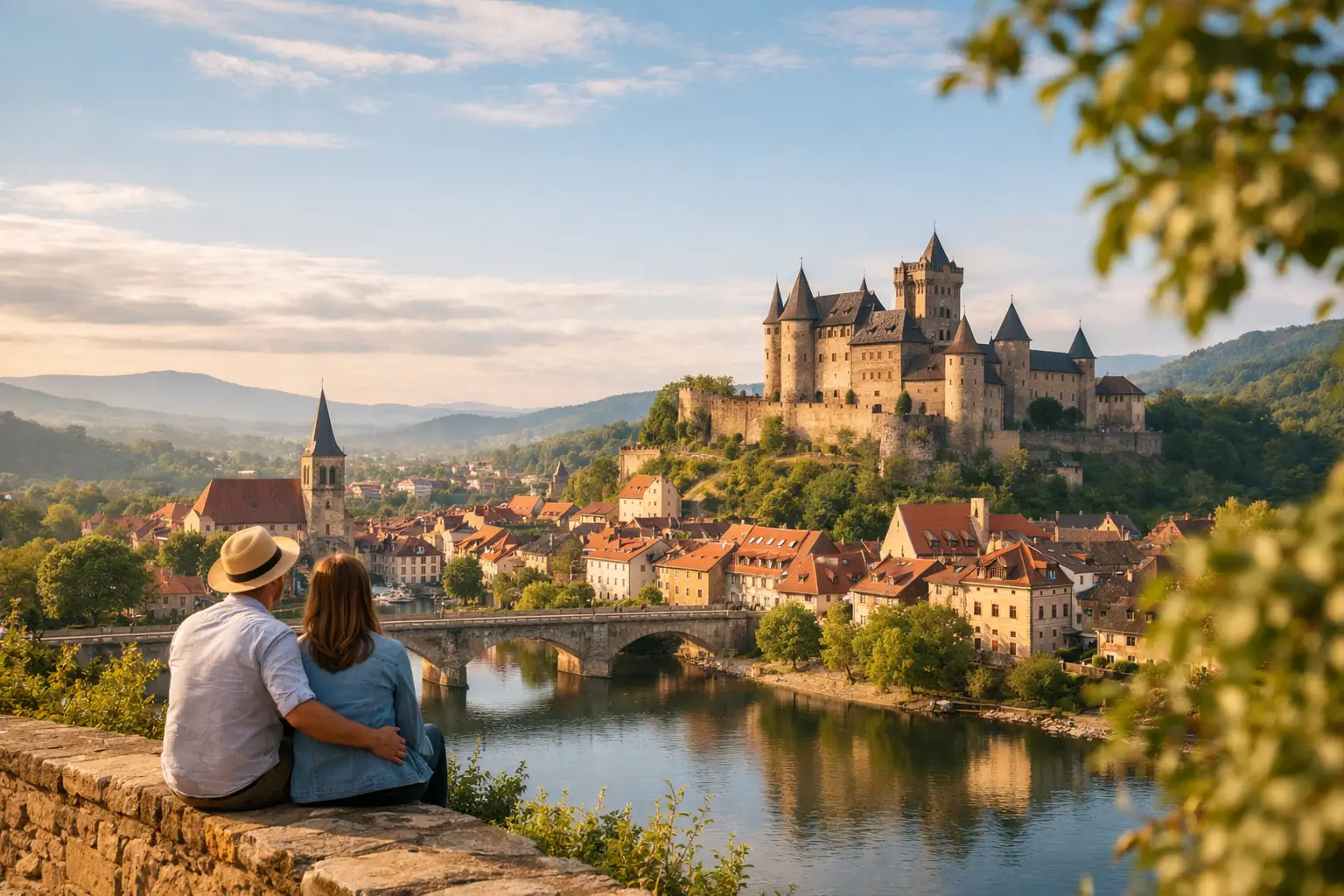
The best castle towns for slow travel are not places to conquer in an afternoon between breakfast and the next motorway exit. They are places that gently rearrange your plans. You arrive intending to see the fortress, then notice a little terrace under a plane tree, a wine list featuring something grown just over the hill, and the sleepy pleasure of hearing church bells mark an hour you have no intention of filling.
For me, a proper castle-town stay has three ingredients: a walkable old centre, a strong sense of its surrounding landscape, and enough good food and drink to justify staying put once the day-trippers have gone home. These eight European towns deliver all three, with stone walls, local character and the sort of evenings that make you forget to check the time.
1. Beynac-et-Cazenac, France
Beynac-et-Cazenac rises above the Dordogne like a film set that somehow forgot to pack up. Its honey-coloured houses tumble down from the formidable Château de Beynac towards the river, while wooden gabare boats drift beneath the cliffs. Climb to the castle early, before the lanes grow busy, then let the rest of the day unfold at river pace.
This is a place for a long lunch of duck, walnut salad and a glass of Bergerac or Pécharmant. The trade-off is that Beynac is tiny and popular in high summer. Stay nearby for several nights, ideally with a car or campervan, and use it as a base for riverside villages, markets and gentle canoe trips rather than trying to tick off every Dordogne château in two days.
2. Kaysersberg, France
Alsace does fairytale charm with a fairly shameless amount of confidence, and Kaysersberg is one of its loveliest expressions. Half-timbered houses lean companionably over flower-filled streets, a clear stream slips through the centre, and the ruined imperial castle keeps watch from the hillside above.
The real pleasure lies in slowing the rhythm down. Walk through the vines towards Kientzheim or Riquewihr, stop at a family tasting room, and return for tarte flambée with a crisp local Riesling. December is magical but crowded; spring and late September offer more breathing space, golden vineyard views and a better chance of claiming a table without a military campaign.
3. Cochem, Germany
Cochem has the sort of Moselle setting that makes you reach for your camera at every bend: steep terraced vineyards, a looping river, timber-framed buildings and Reichsburg Castle perched high above it all. Yes, it can be busy, especially when coach groups roll in, but the town changes personality once evening settles on the water.
Choose a room or pitch just outside the centre and walk in along the river. Spend one day touring the castle and another doing almost nothing more strenuous than tasting Riesling, watching boats pass and taking the chairlift or a vineyard path for the view. Moselle Riesling is wonderfully varied, from bone-dry and slatey to delicately sweet, so there is no need to pretend one glass counts as proper research. It absolutely does.
4. Brisighella, Italy
In Emilia-Romagna, Brisighella sits beneath three dramatic hills crowned by a fortress, a clock tower and a sanctuary. The Via degli Asini, an elevated covered lane once used by donkeys carrying gypsum, gives the old town an unusual, quietly theatrical charm. It is not grand in the way of Florence or Siena. That is precisely the point.
Come hungry. Brisighella is known for excellent olive oil, handmade pasta and the warm, unhurried generosity of Romagnolo cooking. Pair a plate of tagliatelle with a local Sangiovese and leave room for a stroll up to the Rocca Manfrediana as the light softens. A car helps for exploring the surrounding hills, though the town itself rewards those who park up and wander.
5. Monsaraz, Portugal
Monsaraz looks across the Alentejo plains from a hilltop of whitewashed houses, weathered stone and broad, dazzling skies. Its castle walls are less about ornament than position: from the ramparts, the landscape seems to run on for ever, with the vast Alqueva reservoir adding a shimmer of blue to the distance.
This is one of the best castle towns for slow travel when your idea of luxury is silence, space and a bottle opened at sunset. Alentejo reds, often generous and sun-warmed, suit the setting beautifully, especially alongside regional cheese, black pork or a simple plate of olives and bread. Summer can be fiercely hot, so spring, autumn and the cooler shoulder of winter are kinder times to walk the walls and linger outdoors.
6. Motovun, Croatia
Motovun rises from inland Istria above a quilt of forests, vineyards and truffle country. Its walls wrap around a compact medieval hill town, and a slow circuit of the ramparts delivers one of those views that makes a second coffee feel entirely necessary. The surrounding Mirna Valley is greener and gentler than Croatia’s better-known coast, with fewer beach crowds and much more room to meander.
Stay for the flavours. Istrian Malvasia is a bright, food-friendly white for warm afternoons, while Teran has enough savoury depth for truffle pasta and slow-cooked meats. Motovun can feel busy during its summer film festival, which may be either a delight or a logistical nuisance depending on your tolerance for crowds. Outside that period, it is wonderfully calm.
7. Trujillo, Spain
Trujillo in Extremadura is all tawny stone, sweeping plazas and a castle with a view over rooftops that seem baked by the Spanish sun. The Plaza Mayor is grand without feeling stiff, framed by arcades where you can settle into a chair and watch the town conduct its daily business at a pace that feels admirably civilised.
Give Trujillo time beyond the castle visit. Extremadura is celebrated for jamón ibérico, sheep’s cheese and deeply flavourful, unfussy cooking, and it is a fine region for anyone who values a proper lunch. Local wines may not have the international fame of Rioja or Ribera del Duero, but that is part of the pleasure. Ask what is regional, order a glass, and let the bar staff point you towards something new.
8. Sighişoara, Romania
Sighişoara’s walled citadel, with its pastel houses, cobbled slopes and clock tower, feels particularly enchanting in the early morning mist. It is often mentioned in connection with Vlad the Impaler, but the town is more rewarding when treated as a living Transylvanian place rather than a vampire-themed photo stop.
Stay overnight inside or close to the old centre. After the crowds thin, climb the covered Scholars’ Stairs, listen for music drifting from a courtyard restaurant and try a local Romanian red with hearty seasonal cooking. The castle-town atmosphere is strong, but facilities can feel less polished than in France or Germany. For many travellers, that slight roughness is not a drawback. It is part of the texture.
How to make a castle-town break feel genuinely slow
The temptation with castle towns is to build a heroic route: one fortress before lunch, another by tea, perhaps a third if the sat-nav behaves. Resist. Two or three nights in one base usually reveal more than a string of single-night stops. You get the bakery queue, the changing light on the walls, the local wine bar after dinner and the useful knowledge of which lane leads home without consulting your mobile phone.
Aim for one anchor activity a day, whether that is a castle visit, vineyard tasting, market or walk. Leave the rest unscripted. In many of these places, the richest memories come from the small detours: a bottle bought from the producer rather than the supermarket, a conversation with a shopkeeper, a bench with a view and nowhere else to be.
Choose your season with care, too. High summer offers long evenings but brings heat and crowds to smaller towns. Spring delivers wildflowers and fresher energy, while autumn is ideal for vineyards, harvest menus and cooler walks. If you are travelling by campervan, check access before committing to the old centre. Medieval lanes were not designed with reversing cameras in mind.
The castle may be the reason you circle a destination on the map, but let the town beneath it be the reason you stay. Order the local bottle, take the longer lane back to your room, and give the place enough time to become more than a photograph.
If you’re looking for tours, attractions and experiences across the UK and Europe, you can browse and book here: https://tripadvisor.tpk.ro/D6WNK34w
Affiliate Disclaimer
This article contains affiliate links. If you book tours, attractions or experiences through these links, we may earn a small commission at no additional cost to you. We only recommend services that we genuinely use,