
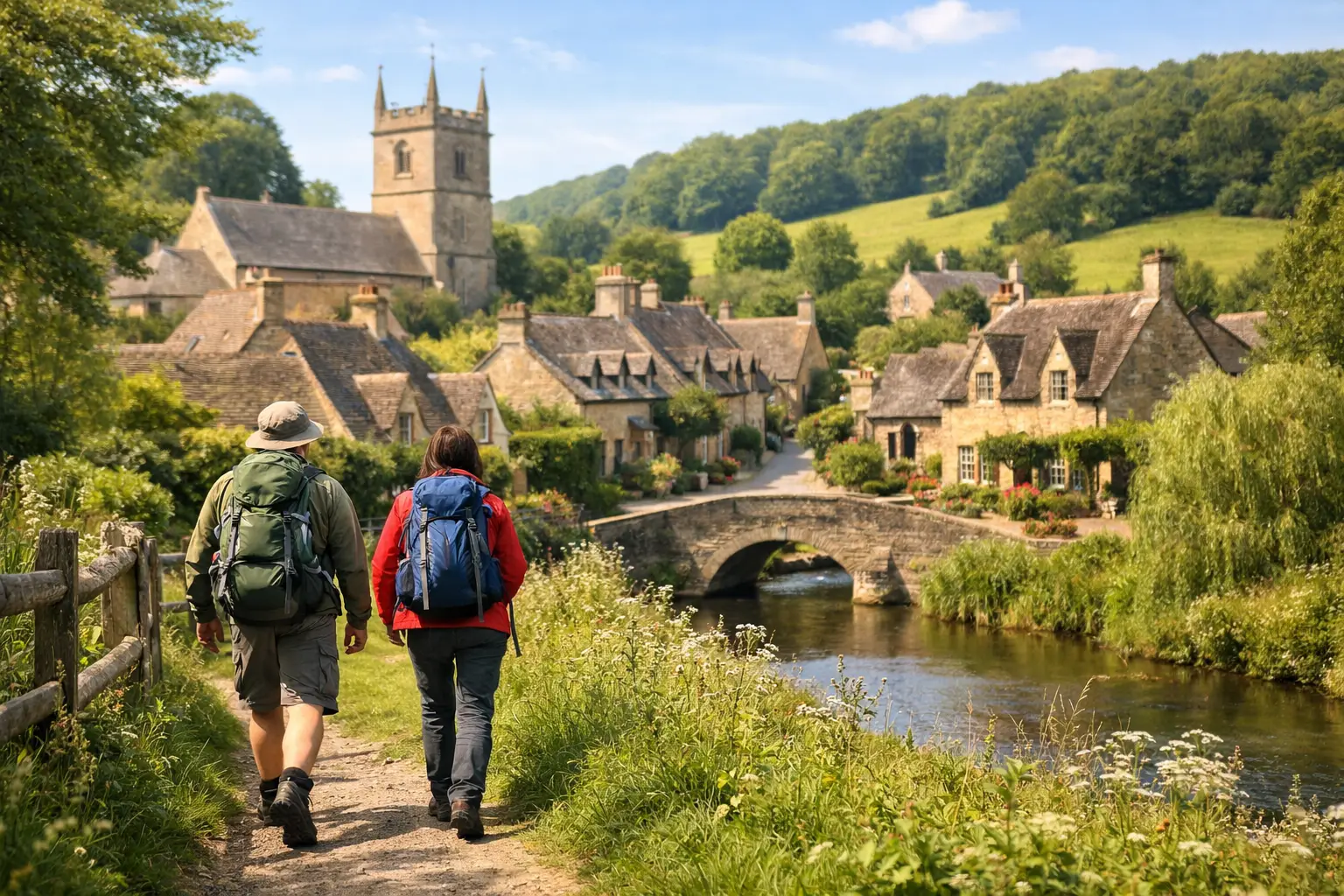
10 Best English Villages for Walkers
There is a particular kind of holiday moment that England does brilliantly. You lace your boots in a quiet village, step past a stone church and a bakery still smelling of warm buns, and within ten minutes you are on a footpath with nothing ahead but fields, dry-stone walls or a sweep of sea. The best English villages for walkers are not just pretty bases on a map. They have that lovely mix of easy access to footpaths, somewhere civilised to eat afterwards, and enough character to make you slow down rather than march through.
What follows is not a race for the most dramatic summit or the hardest mileage. It is a selection for people who like a walk with atmosphere – a village green, a proper pub, a market town within reach, perhaps even a local wine bar or a good pint waiting at the end. Some are famous, some a little quieter, but all reward the sort of traveller who prefers rambling to rushing.
Ppsst! We use NordVPN for total cybersecurity!
What makes the best English villages for walkers?
A good walking village needs more than postcard looks. It should offer a choice of routes straight from the door, because there is something deeply satisfying about setting off on foot without moving the car. It also helps if the terrain gives you options. Some days suit a stiff climb and a long view, and some days call for a level riverside path followed by lunch.
The villages below earn their place because they combine scenery with staying power. They are places where you can happily spend a weekend, not just snap a photo and leave. And, since this is England, they also have that all-important post-walk comfort factor.
Castle Combe, Wiltshire
Castle Combe is almost unfairly beautiful. Honey-coloured cottages gather around the Bybrook River, and the whole village seems to have been arranged by someone with a weakness for stone bridges and roses. Yet it is more than a pretty face. Walking from here gives you access to a softer, greener side of the Cotswolds, with rolling fields, wooded valleys and quiet lanes.
One of the pleasures of Castle Combe is that the walks feel gentle on the eye even when they stretch the legs. Circular routes towards Ford and North Wraxall offer meadows, streams and that easy rhythm of opening gates and following hedgerows. This is not the village for wild, rugged drama. It is for a slower kind of walking, the sort that encourages a long lunch and perhaps a glass of something crisp before supper.
Grasmere, Cumbria
If your idea of walking includes proper fells, changing skies and the chance of coming back with rosy cheeks and muddy trousers, Grasmere is hard to beat. The village itself has an old soul – whitewashed buildings, snug inns, bookish corners and a lake that catches the light beautifully when the weather behaves. When it does not, it still looks romantic, just with more waterproofs.
From Grasmere, you can keep things easy with a lakeside stroll or go bigger with climbs towards Easedale Tarn, Helm Crag or Fairfield. That range matters. Not everyone in a travelling couple wants the same level of punishment before lunch. The village handles both ambitions rather well. There is also a cosy literary air here, which suits a slower evening with dinner and a decent glass of red.
Broadway, Worcestershire
Broadway has a grander, more polished feel than some walking villages, but it earns its place. The broad high street is lined with handsome stone buildings, galleries and places to linger over coffee, and the surrounding countryside is classic escarpment country. The walk up to Broadway Tower is the obvious choice, and with good reason. The views across the Vale of Evesham are expansive and rewarding, especially on a clear morning.
What I like about Broadway is the contrast. You start among elegant buildings and end up on open hillside where the wind has its say. It is ideal for walkers who like a bit of village glamour alongside their rambling. If you are travelling through the Cotswolds by car or campervan, this is one of those stops that feels easy and polished without losing its rural charm.
Hawkshead, Cumbria
Hawkshead feels made for wandering, with its little passages, whitewashed houses and old courtyards. It sits in a lovely position between Esthwaite Water and the bigger Lake District scenery, which means you can have a satisfying day on foot without throwing yourself at the busiest honeypot routes.
Walks from Hawkshead can be modest and mellow or more ambitious if you head towards Tarn Hows and the surrounding hills. The village also suits those who enjoy a bit of culture stitched into the landscape. There is history here, and a sense of old Lakeland life that survives the souvenir shops. It can be busy in peak season, certainly, but early starts solve a lot, and the evening hush is often worth waiting for.
Clovelly, Devon
Clovelly is not a village for anyone who dislikes steep gradients. It tumbles down towards the sea in a cascade of white cottages and cobbled lanes, and just reaching the harbour can feel like a warm-up. Still, for coastal walkers, it is memorable in a way few villages are. The South West Coast Path nearby delivers big sea views, cliff-edge drama and that salty, windblown satisfaction only seaside walking seems to manage.
The trade-off is obvious. This is not easy terrain, and the cobbles can be awkward underfoot. But if you enjoy a walk with character, gulls overhead and the promise of seafood afterwards, Clovelly is a splendid choice. It feels cinematic, slightly theatrical, and completely committed to its own charm.
Malham, North Yorkshire
Malham has walkers in its bones. Set in the Yorkshire Dales, it gives you direct access to some of the most striking natural landmarks in England: Malham Cove, Gordale Scar and Janet’s Foss. Even a relatively short circuit from the village delivers limestone drama that feels larger than life.
This is a village for people who want their walk to have shape and spectacle. The paths can be busy, yes, especially in fine weather, but there is a reason. The landscape is superb. There is also something pleasingly honest about Malham. Boots are muddy, dogs are tired, and nobody is pretending they only came for a gentle saunter.
Shere, Surrey
Not every great walking village needs to be remote. Shere, tucked into the Surrey Hills, is one of the best English villages for walkers who want countryside within easy reach of London. It has a stream, an ancient church, timber-framed buildings and enough charm to make you wonder whether someone has quietly styled the whole place for the cinema.
The walking is wonderfully varied. You can head into the wooded folds of the Surrey Hills, climb for broad views, or stick to gentler routes through meadows and lanes. Shere suits a weekend when you want green scenery and a good pub without committing to a full-scale expedition. It is also a reminder that excellent walking does not always need mountain grandeur.
Painswick, Gloucestershire
Painswick has a slightly more tucked-away, contemplative feel than some Cotswold favourites. Known for its handsome stone houses and famous churchyard, it also sits close to the Cotswold Way, which makes it a strong base for walkers who enjoy long-distance trail atmosphere without giving up comfort at night.
The surrounding landscape is all folds and viewpoints, with routes through beech woods, pasture and escarpment edges. In spring and early autumn, it is particularly lovely. This is a village that invites a slower pace. You notice gardens, church bells, changing light on stone. If your ideal walking break includes beauty without too much bustle, Painswick delivers.
Robin Hood’s Bay, North Yorkshire
Robin Hood’s Bay has one of the finest arrivals in England. The village drops dramatically towards the North Sea, its red-roofed houses clustered above the harbour, and from the clifftop path the whole scene looks almost too perfect. For walkers, the appeal is immediate. You are right on the Cleveland Way, with excellent coastal walking in both directions.
A route towards Whitby offers classic North Yorkshire coast scenery, while heading south gives you expansive views and a glorious sense of space. The village itself is steep and full of character, with narrow alleys and sea air in every corner. It can be blustery, and that is part of the point. Few places feel so briskly alive.
Beer, Devon
A village called Beer already has my attention. Happily, it also deserves yours if you like coast walks with a softer, friendlier feel than some of Devon’s more dramatic spots. Set around a lovely shingle beach with white cliffs nearby, Beer is a charming base for exploring this stretch of the Jurassic Coast.
Walk east or west and you get classic South West Coast Path rewards: rolling clifftops, sea views and that familiar pattern of descent followed by a rather sharp climb. The village has an easy-going atmosphere that suits walkers well. After a day on the path, sitting down to fresh fish and something chilled feels less like indulgence and more like sensible recovery.
Choosing the right village for your walking style
It really does depend on what kind of walker you are. If you want steep climbs and dramatic scenery, Grasmere and Malham will probably tempt you most. For coastal energy and salt in the air, Clovelly, Robin Hood’s Bay and Beer all have real pull, though each asks something different of your knees.
If your ideal day includes moderate walking, old stone cottages and a very decent lunch, Castle Combe, Broadway and Painswick are safer bets. And if you want countryside close to a city break or a shorter weekend, Shere is wonderfully convenient without feeling compromised.
The nicest way to approach these places is not to cram in as many miles as possible. Stay two nights if you can. Start early once, start late another day. Leave room for a slow pint, a bakery stop, and the kind of detour that happens when a lane looks interesting. That, after all, is the real pleasure of an English walking village – not just the path ahead, but the life around it.
Affiliate Disclaimer
Some links on this blog may be affiliate links. This means that, at no additional cost to you, we may earn a small commission if you make a purchase through those links. We only recommend products, services, destinations, and experiences that we genuinely use, enjoy, or believe may be useful to fellow travellers and narrowboat enthusiasts. Thank you for supporting Vineyards and Villages and helping to keep our adventures afloat.





One Comment
Comments are closed.