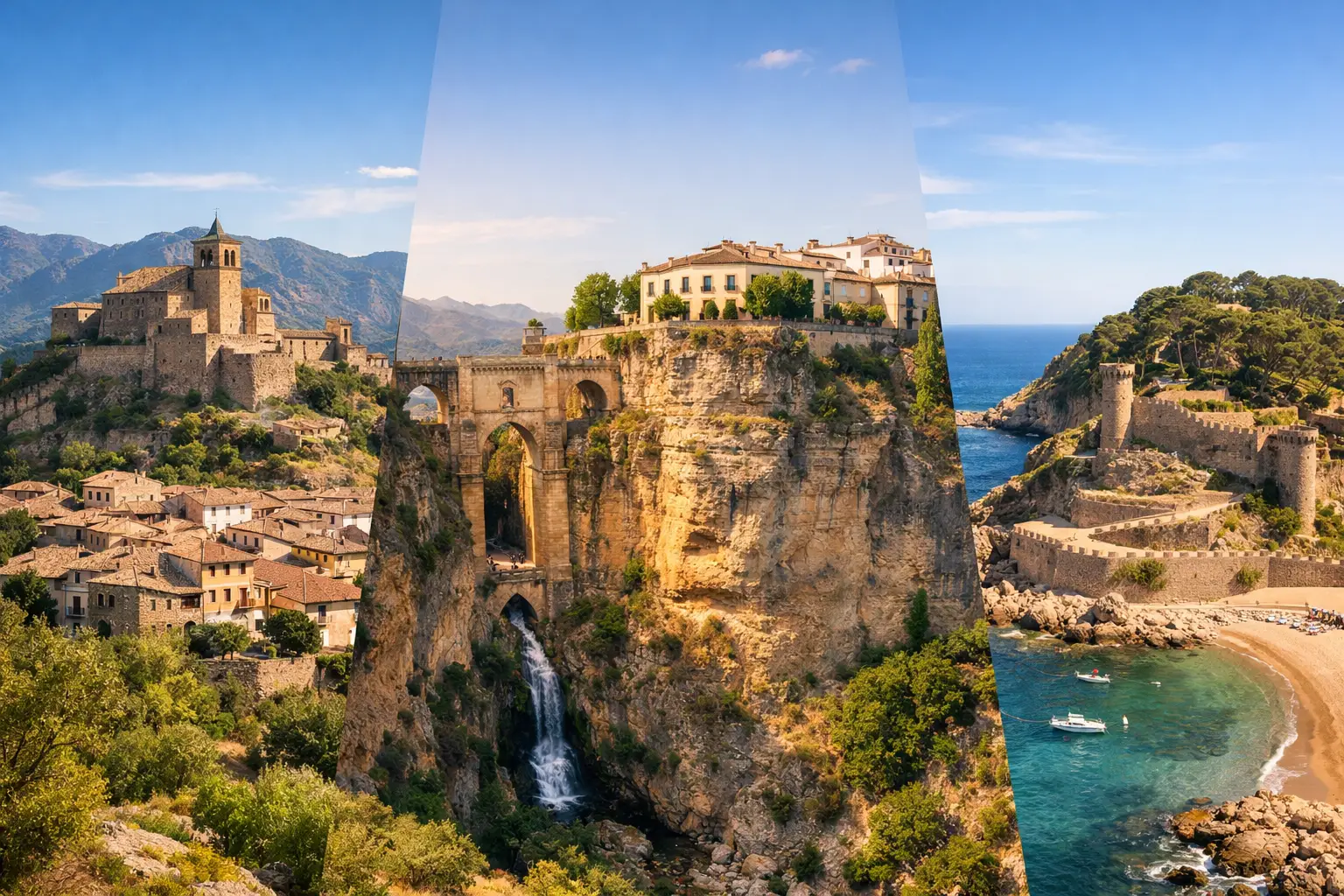
10 Historic Towns in Spain Worth the Detour
Some places ask for a checklist. Others ask you to slow your pace, order another glass, and stay until the light changes on the stone. The best historic towns in Spain belong firmly in the second camp. They are places where a Roman wall, a Moorish arch, a medieval square and a slightly sleepy wine bar can all sit within the same afternoon.
What I love most about travelling through Spain’s smaller historic towns is that they rarely feel staged. You arrive for the architecture, perhaps, but you remember the clink of plates in a tucked-away plaza, the scent of warm bread drifting from a bakery, or the first sip of a local red that suddenly makes the whole landscape make sense. For travellers who like a journey to unfold gently, these towns offer far more than a photogenic old quarter.
Why historic towns in Spain are made for slow travel
Spain does grand cities brilliantly, of course, but its smaller historic towns often deliver the richer, more intimate experience. You can walk them easily, linger over lunch without feeling you are missing half the sights, and notice how history shows up in ordinary life. Laundry hangs near a 12th-century church. Elderly neighbours chat beneath carved balconies. A cellar door opens onto a cool stone room where regional wine is poured without fanfare.
That rhythm matters. If you are road-tripping, travelling by campervan, or simply trying to avoid the rush of city hopping, these towns reward unhurried days. They also tend to sit close to vineyards, olive groves, mountain routes or river valleys, which means the drive in is often part of the pleasure.
10 historic towns in Spain worth your time
1. Pedraza, Castile and León
Pedraza feels almost improbably preserved, as if someone quietly agreed centuries ago not to tamper with it too much. You enter through a medieval gate and suddenly the streets narrow into worn stone lanes, lined with honey-coloured houses and heavy wooden doors.
It is not a large place, and that is exactly the point. Come in the late afternoon, when the day-trippers thin out and the square begins to glow. This part of Castile and León is also lamb country, so dinner has a grounded, hearty character. Pair it with a Ribera del Duero red from nearby and the whole place settles into focus.
2. Laguardia, Rioja Alavesa
If your affection for old towns is matched by a love of wine, Laguardia is hard to resist. This hilltop town in Rioja Alavesa is wrapped in medieval walls and surrounded by vines, with a landscape that looks especially beautiful in autumn when the leaves begin to turn.
Under the town, there are historic underground cellars carved into the rock, and above ground the streets have that lovely mix of gravity and warmth that Spain does so well. It can be busier than some other towns on this list because wine travellers know exactly what is here, but it still feels rooted rather than polished for show. Stay overnight if you can. The evenings are better than the midday rush.
3. Albarracín, Aragón
There are towns that are beautiful, and then there is Albarracín. Rising in pink and ochre tones above a curve of river, it has the kind of silhouette that makes you slow the car before you have even parked.
Its old centre climbs steeply, so it is less about aimless strolling and more about taking your time. The reward is in the views, the unusual local architecture, and the sense of being folded into a landscape that has protected the town for centuries. This is not a wine destination in the same way Rioja is, but the food is deeply regional and satisfying, and the setting more than earns its place on any slow-travel route.
4. Santillana del Mar, Cantabria
Santillana del Mar is one of those places that travellers sometimes fear will feel too famous or too tidy. It is certainly well known, and yes, it can be busy. But arrive early or stay into the evening and its beauty feels entirely justified.
The stone mansions, flowered balconies and Romanesque church give it a stately air, yet it still has corners that feel personal and quiet. This is a good stop if you are heading through northern Spain and want a change from vineyard landscapes. Order local cheeses, anchovies if you enjoy them, and a glass of something crisp from the north. The Atlantic influence gives the region a freshness that suits the town.
5. Trujillo, Extremadura
Trujillo has one of the finest plazas in Spain, broad and dramatic yet somehow still inviting. The town climbs from it in a tumble of palaces, churches and old houses, all watched over by a hilltop castle.
Extremadura does not always get the same attention as Spain’s better-known wine regions, but that can be part of its appeal. The food here is excellent, from cured ham to rich local cheeses, and the surrounding countryside feels spacious and unhurried. Trujillo suits travellers who like history with a little roughness around the edges rather than neat perfection.
6. Besalú, Catalonia
Crossing the bridge into Besalú is half the pleasure. The Romanesque structure, with its angular gateway tower, gives the town a cinematic arrival, but what follows is more subtle and more interesting.
Besalú carries traces of medieval Jewish history as well as its Christian past, and that layered identity gives the town depth beyond its postcard appeal. Catalonia’s food culture helps too. A simple lunch here can become memorable very quickly, especially with a local Garnacha or a fresh white from nearby Empordà.
7. Peñafiel, Castile and León
Peñafiel is often associated first with wine and then with history, but the truth is that the two are intertwined. Its long, ship-like castle dominates the skyline, while the surrounding Ribera del Duero landscape delivers one of Spain’s most satisfying combinations of big scenery and serious reds.
The town itself is not as uniformly pretty as somewhere like Albarracín, and that is worth saying plainly. But if you value substance over prettiness, Peñafiel is rewarding. It feels lived in, purposeful and deeply connected to the region’s wine culture. It is especially good as part of a broader road trip through the Duero valley.
8. Cáceres, Extremadura
Cáceres is technically a city, but its old town has the enclosed, stone-bound feeling of a much smaller historic settlement, so I am including it without apology. Walking through it at dusk feels like stepping into a place that has barely noticed the centuries passing.
Its blend of Roman, Islamic, Gothic and Renaissance elements is extraordinary, yet what stays with me is the atmosphere. The lanes are cool and quiet, the buildings severe in the best possible way, and the food scene gives the place a modern pulse without spoiling its historic core. If you want one of the most immersive old quarters in Spain, this is it.
9. Frías, Burgos
Frías often claims the title of one of Spain’s smallest cities, but in feel it is very much a hilltop town, and a splendid one. Houses appear to cling improbably to the rock, with the castle rising above them in a way that seems designed for dramatic weather and strong photographs.
What I like about Frías is its scale. You can absorb it in a short visit, yet it leaves a clear impression. It works beautifully on a driving route through northern inland Spain, especially if you enjoy those less publicised places that still feel like a discovery.
10. Ronda, Andalusia
Ronda is no secret, and during peak periods it can feel that way. Still, there is a reason people go. The gorge is astonishing, the setting is theatrical, and the old town has enough depth to keep it from becoming a mere viewpoint stop.
It also sits in one of Andalusia’s increasingly interesting wine areas, which gives the visit another layer. If crowds are your concern, avoid the middle of the day and stay the night. Once evening arrives and the coaches have gone, Ronda regains some of its gravity and romance.
How to choose the right historic town in Spain for your trip
It depends on what kind of journey you want. If wine is central, Laguardia and Peñafiel make obvious sense, with Ronda as a more unexpected addition. For pure visual drama, Albarracín and Frías are especially memorable. If food and atmosphere matter as much as architecture, Trujillo and Cáceres are deeply satisfying.
Season matters too. Northern towns can be wonderful in summer when inland Spain is intensely hot, while Rioja and Ribera del Duero are particularly lovely around harvest. In high season, the most famous towns can feel crowded from late morning through mid-afternoon, so sleeping nearby or arriving outside the obvious hours changes the experience entirely.
The pleasure of staying longer
One of the easiest mistakes in historic towns is treating them as short scenic stops. You tick off the bridge, the castle, the main square, then move on. But these places often come into their own in the pauses – an unplanned glass of local wine, an extra wander before supper, the quiet between lunch and evening when the streets seem to exhale.
That is where a brand like Vineyards and Villages always feels most at home: in the moments when a destination stops being a sight and becomes a mood. If you give these towns a little more time than your itinerary first suggests, they tend to give something back.
Spain has no shortage of grand landmarks, but its smaller historic places are where travel often feels most personal. Choose one or two, build in room to linger, and let the day be shaped by church bells, old stone and whatever is being poured nearby.
Affiliate Disclaimer
This post may contain affiliate links. If you book accommodation, tours, travel products, or services through these links, Vineyards and Villages may earn a small commission at no extra cost to you. These commissions help keep our campervan adventures, travel stories, and slightly questionable parking decisions on the road. Thank you for your support!