12 Best Villages in Provence to Visit
There is a particular moment in Provence when a village stops feeling like a postcard and starts feeling personal. It might be the clink of glasses under plane trees in a shaded square, the smell of warm thyme drifting off a hillside, or the sight of honey-coloured stone catching the last of the evening sun. If you are looking for the best villages in Provence, you are really looking for places that invite you to slow down, linger over lunch, and let the day unfold properly.
That is why Provence is so easy to love and so difficult to rush. The finest villages here are not just pretty. They have rhythm, character, and that lovely lived-in feeling that makes you want to stay beyond the day trip crowd. Some are famous for good reason, some feel quieter and more intimate, and each suits a slightly different kind of traveller.
How to choose the best villages in Provence
The truth is, the best villages in Provence depend on the sort of journey you want. If your dream is lavender fields and perched hamlets, the Luberon will probably steal your heart. If you want rosé, olive groves, and a base for slow drives between wineries, the Var has strong appeal. If food markets, Roman history, and a little more bustle sound right, villages near Avignon and the Alpilles may be a better fit.
For me, the most memorable Provençal villages are the ones that offer more than a quick photograph. I want a good morning market, a church bell in the background, a modest café doing something delicious with tomatoes and goat’s cheese, and a bottle of local wine that makes sense in the landscape around it. Those are the places below.
1. Gordes
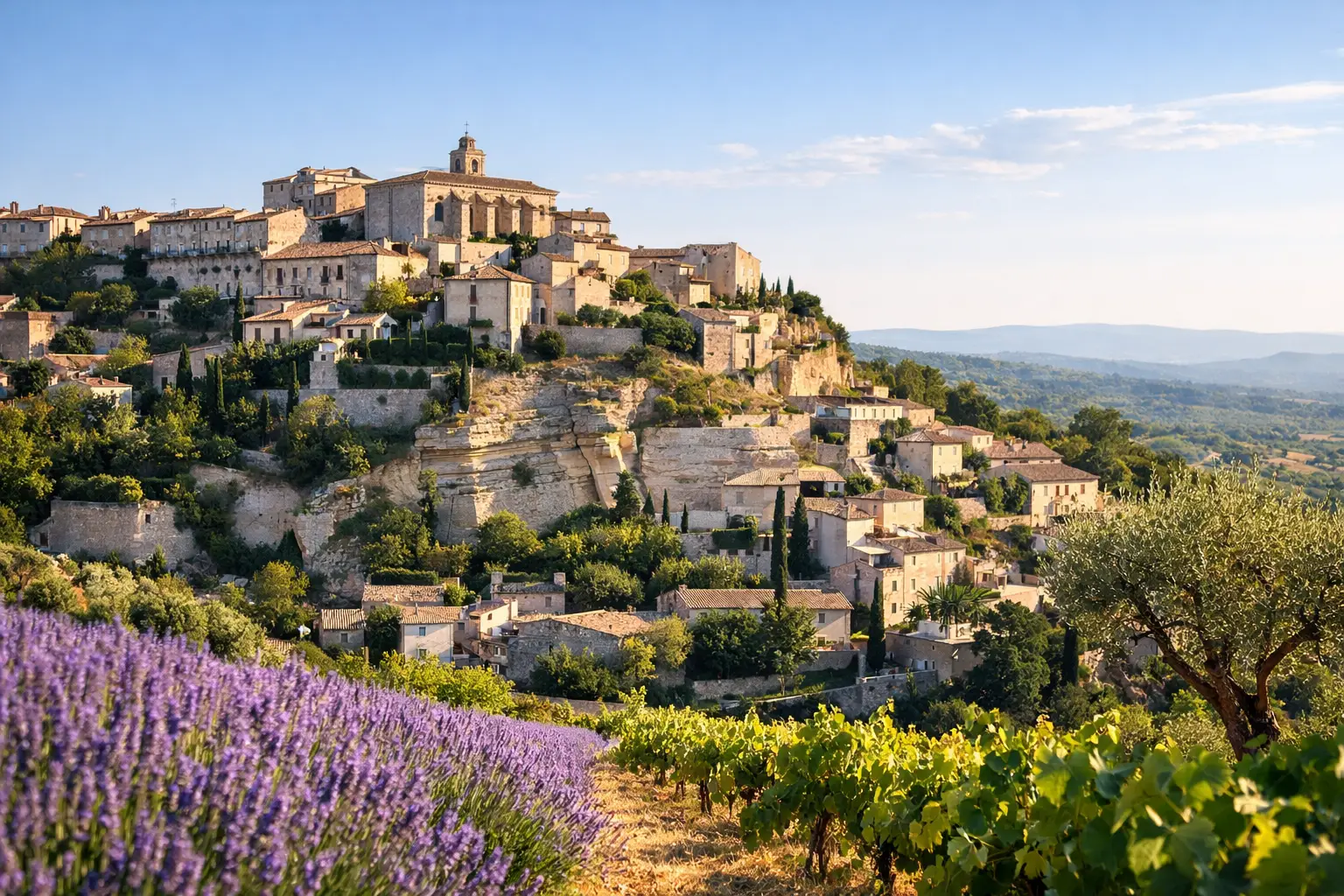
Gordes is one of the villages people picture before they even arrive in Provence. It rises in terraces above the valley, all pale stone and dramatic angles, and from a distance it looks almost unreal. Up close, it is still beautiful, though it can be busy in high season and that is worth knowing before you go.
Even so, Gordes earns its reputation. Early morning and late afternoon are when it feels most magical, when the coach groups thin and the streets recover their quiet. Nearby vineyards and the famous abbey at Sénanque make it especially appealing if you like pairing village wandering with a scenic drive and a glass of something chilled at the end of it.
2. Roussillon
Roussillon feels different from almost every other village in the region because of its ochre cliffs and painted facades. Instead of the familiar creamy limestone, you get shades of rust, burnt orange and soft pink that glow in the sun. It is a village with real warmth, visually and emotionally.
This is a wonderful stop if you enjoy colour, art, and a landscape that feels slightly unexpected. The walks around the ochre trail are lovely, but the village itself is the reward – shutters in faded tones, small galleries, and restaurants where a carafe of local rosé seems entirely right. It is popular, yes, but its atmosphere is gentler than some of Provence’s headline names.
3. Ménerbes
Ménerbes has that composed, quietly self-assured charm that can be hard to describe until you are there. It sits elegantly on its ridge, looking over vineyards, cypress trees and the folds of the Luberon countryside, and it never seems to try too hard. It simply knows it is lovely.
For wine lovers, this is one of the most satisfying villages to include on a road trip. The wider area is threaded with vineyards and cellar doors, and the surrounding scenery has exactly the kind of measured beauty that suits a long lunch. Ménerbes feels less theatrical than Gordes, which many travellers will count as a virtue.
4. Lourmarin
If I were choosing a village for a relaxed overnight stay, Lourmarin would be near the top of the list. It has elegance but also ease – the kind of place where you can browse a market in the morning, settle into a café terrace for far too long, and drift into the evening with no real plan beyond dinner and wine.
There is a slightly more cosmopolitan feel here than in some perched villages, which makes it especially appealing for travellers who want charm without too much steep climbing or overt quaintness. The château adds interest, the market adds life, and the surrounding wine country gives you every excuse to stay local with what is in your glass.
5. Bonnieux
Bonnieux stretches along a hillside and rewards anyone willing to climb. The higher you go, the better the views become, with the patchwork of vineyards and cherry orchards opening out below. It feels like a village that reveals itself in layers.
What I love about Bonnieux is that it still feels rooted in everyday life. There are beautiful old buildings, of course, but there is also a grounded, practical Provençal rhythm to it. It works well as part of a Luberon route with Lacoste and Ménerbes, especially if you enjoy scenic driving and stopping often for a photograph, a coffee, or a quick look at a village church.
6. Lacoste
Lacoste is smaller in feel, quieter in mood, and wonderfully atmospheric. Its stone lanes wind uphill towards the ruined château associated with the Marquis de Sade, and the village has a slightly more austere beauty than some of its neighbours. That restraint is part of the charm.
This is not the place for a packed itinerary. It suits a slower kind of afternoon, one where you wander without needing to tick anything off. If you like villages that still hold onto silence, especially outside peak summer, Lacoste can be deeply memorable.
7. Les Baux-de-Provence
Les Baux-de-Provence is dramatic in a very different way. Perched on a rocky outcrop in the Alpilles, it feels almost cinematic, with its ruined citadel, wide views and wind-shaped landscape. It is more visited than intimate, but sometimes a place is famous because it genuinely stirs something in you.
The trade-off here is straightforward. You come for spectacle and setting more than quiet authenticity. Go early or stay later in the day and it becomes easier to appreciate its wild beauty. Pair it with olive oil tastings and a drive through the Alpilles, and it makes perfect sense.
8. Saint-Rémy-de-Provence
Saint-Rémy is technically more of a small town than a village, but leaving it out would feel stubborn. It has style, excellent food shops, a handsome centre and enough activity to make it a very comfortable base. If some Provençal villages feel better for a few hours, Saint-Rémy can carry several days with ease.
This is a good choice if you want village character with practical comforts. The market is one of the region’s pleasures, and the mix of cafés, boutiques and nearby vineyard country makes it especially attractive for couples who want beauty without isolation. It is polished, yes, but not soulless.
9. Venasque
Venasque often gets less attention than the big Luberon names, which is precisely why many people end up loving it. It is perched, peaceful and beautifully preserved, with stone houses, old ramparts and expansive views over countryside that seems to roll on forever.
There is a softness to Venasque that makes it ideal for travellers craving calm. You are less likely to feel jostled here, more likely to hear swallows overhead and the scrape of chairs on a terrace. If Provence for you means stillness rather than scene, this is a strong contender.
10. Seillans
Seillans, in the Var, has the kind of winding medieval centre that rewards getting slightly lost. The streets curl around fountains and archways, bougainvillaea spills over walls, and the whole place feels deeply southern in the best possible way.
It is also a good reminder that Provence is broader than the standard Luberon circuit. If your travels are taking you towards rosé country, Seillans offers village beauty with easier access to the vineyards and sun-drenched back roads of inland Var. It feels less talked about and all the better for it.
11. Cotignac
Cotignac has one of the most distinctive settings in Provence, tucked beneath a dramatic limestone cliff with cave dwellings carved into the rock. It sounds almost theatrical, yet the village itself feels grounded and easygoing, with a lovely central square shaded by plane trees.
This is the sort of place where lunch stretches naturally into the afternoon. There is enough life here to feel welcoming, but not so much that it loses its sense of place. If your ideal Provençal stop includes market produce, chilled rosé and a little geological drama, Cotignac is hard to resist.
12. Ansouis
Ansouis tends to be one of those villages people mention with a slightly knowing smile, as if reluctant to oversell it. It has a château, narrow lanes, old stone houses and a gracious, understated beauty that lingers.
What makes Ansouis special is its balance. It is charming without feeling over-curated, refined without being stiff. For travellers who want a village that still feels personal, and who enjoy combining food, wine and slow walking, it is one of Provence’s quieter triumphs.
A few practical thoughts before you go
If you are building a route around these villages, fewer stops usually means a better experience. Provence is not at its best when you are racing from one car park to the next. Two or three villages in a day is often enough, especially if you want time for lunch, a market, or a detour to a vineyard.
Season matters too. July and August bring energy, lavender and long evenings, but also heat and crowds. May, June, September and early October often feel more generous. You can park more easily, book dinner without military planning, and enjoy the villages when they still belong, at least partly, to the people who live there.
And if wine is part of the reason you are coming, let it be a thread rather than a checklist. Provence does rosé beautifully, of course, but there are also elegant reds, bright whites and local bottles that taste even better when opened after a dusty walk through a hilltop village. That, really, is the charm of this region. You do not just see it. You sip it, smell it, and carry it home with you long after the holiday ends.
Affiliate Disclaimer
This post may contain affiliate links. If you book accommodation, tours, travel products, or services through these links, Vineyards and Villages may earn a small commission at no extra cost to you. These commissions help keep our campervan adventures, travel stories, and slightly questionable parking decisions on the road. Thank you for your support!